2026: Sniper or Shotgun? Designing My Project Constellation.
The natural evolution of the product maker

The other day, while working on my goals for 2026, I found myself facing a significant dilemma when tackling one of the central blocks of my year. I'm referring to the plan I've been discussing here in Fika: building a constellation of side projects.
The goal is to learn and, if I get lucky, build something that genuinely provides passive income... or allows me to acquire the skills for what might, possibly in the future, be my "great project" (who knows ;)).
However, during that planning exercise, a strategic doubt assailed me: Should I focus on a single product or launch several at the same time?
It's complicated. For a person like me, with so many hobbies and interests, focusing on a single thing is almost unnatural. But, at the same time, the fear always arises: Can the lack of focus kill the viability of the project?
I had two paths:
Serial Approach: Go product by product. See if it "flies," establish metrics, and after a period (e.g., two months), decide whether it makes sense or if I move to the next one.
Parallel Approach: The one I've been following for a while. Launch several products at once and divide my free time among them, meeting weekly milestones.
My great fear with the second option was whether that dispersion would prevent me from giving each project enough care to make it work.
The Moment of the Click
Despite the doubts, I decided to stick with my inertia: think up, ideate, and launch different mini-projects. But the real validation, the moment of the click to trust this approach, came thanks to a series of tweets from two figures I greatly respect: Marc Lou and Pieter Levels.
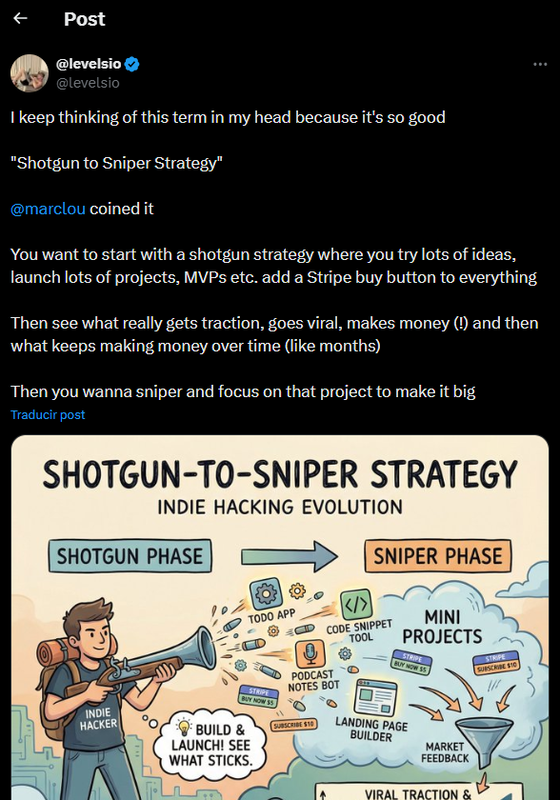
Their philosophy confirmed what I suspected: we shouldn't overthink it.
The key is to get out there and solve problems the best way you know how, with your skills, your experience, and your vision of the world. Ideas alone do not win. Execution and distribution win. And to know what triumphs, you indeed have to launch many things, iterate, and learn what the market wants.
Essentially, this strategy responds to a concept that I love: increasing my 'Luck Surface Area'. If I bet everything on a single card, I limit my chances of success to a binary event: it works or it doesn't. By creating a constellation of projects, I am not dispersing myself, I am buying more lottery tickets. I am expanding the ground where luck can land. As they say, luck is what happens when preparation meets opportunity, and I want to generate as many opportunities as possible.
2026: The year of transition.
The plan for 2026 remains clear: work on each of the launched projects until a series of milestones are met, where I will decide which ones to abandon and which ones to continue.
Furthermore, there is a hidden advantage in this apparent chaos: asset recycling. What I build for a failed project becomes the foundation for the next one. The authentication system, the landing page design, or that email automation... nothing is thrown away. Every 'failure' leaves behind code or learning that drastically accelerates the next launch. My goal is not just to create products; it's to create my own ecosystem where launching project number 5 costs me a fraction of the effort that project number 1 cost. My goal is to learn... but if I "win the lottery" along the way, that's a bonus.
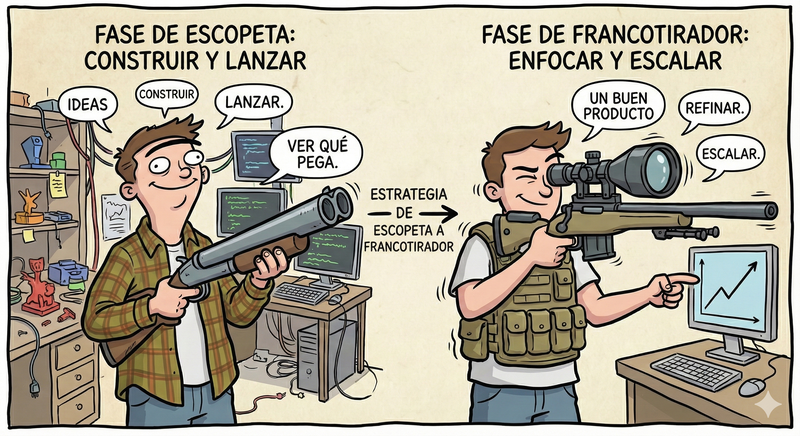
These days, new ideas have emerged related to problems we see at Samara and other startups. I have several mini-products developed and others pending. We will continue with this "shotgun" strategy to, little by little, transition to a sniper profile with those products that show traction and scalability (if that ever happens :)).
Let's keep going!
Gonz.
¿Tienes ganas de más? Visita itwasgonz.com para conocerme mejor.
Comments
No comments yet. Be the first to comment!